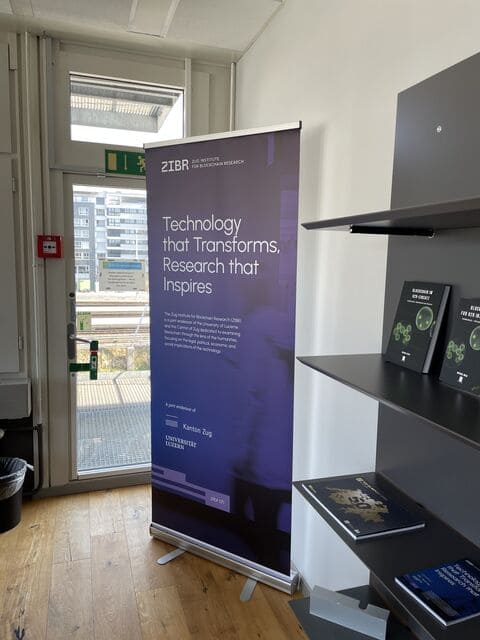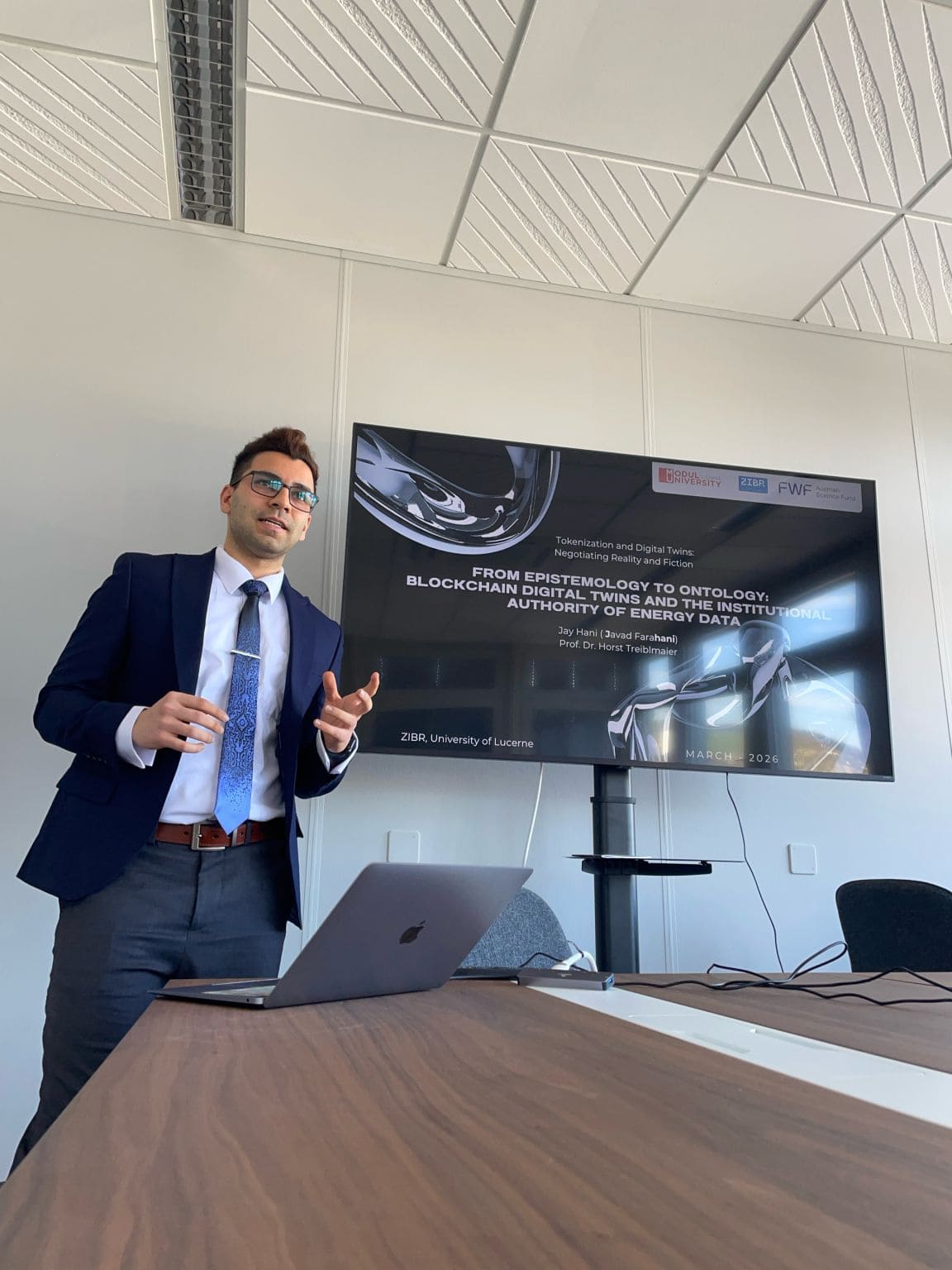
I recently had the pleasure of participating in the workshop “Tokenization and Digital Twins: Negotiating Reality and Fiction” at the Zug Institute for Blockchain Research (ZIBR), University of Lucerne.
At the workshop, I presented my talk, “From Epistemology to Ontology: Blockchain Digital Twins and the Institutional Authority of Energy Data.” As outlined in my presentation, the core argument was that blockchain-mediated digital twins can shift data from an epistemic tool of verification to an ontological instrument of recognition, ownership, and coordination.
From representation to institutional authority
A central question in the presentation was deceptively simple: when energy is produced, which record becomes institutionally real? Is it the electricity produced, the sensor record, the blockchain entry, or the tokenized claim attached to it? My argument explored how, in blockchain-based energy systems, institutions may increasingly rely not on the physical event alone, but on its validated digital representation.
This marks an important conceptual shift. In the traditional view, data describes reality and supports later decision-making. In the framework I presented, data does more than describe. Once linked to blockchain infrastructure and smart contracts, records can trigger decisions, enforce outcomes, and participate directly in the production of institutional reality.
Why blockchain digital twins matter in energy systems
The presentation defined the digital twin as a live digital model of a physical asset, such as a solar panel system, battery, smart meter, or wind turbine. When blockchain infrastructure is added, two features become especially important: immutability and automatic institutional action. In this configuration, records are no longer passive documentation. They become part of rule-bearing infrastructure.
In practical terms, this means that blockchain-mediated digital twins can shape what counts as production, who owns a claim, who gets paid, who is responsible, and which transactions are recognized as valid. That is precisely where the issue of institutional authority becomes significant. When automated systems rely on validated digital records, the digital twin does not simply mirror reality; it can become an authority system within governance and exchange.
Energy data, tokenization, and programmable governance
One part of the talk illustrated this dynamic through the example of a community energy DAO. In such a setting, verified production data can be used to set prices, distribute incentives, guide storage decisions, and settle peer-to-peer exchanges automatically. Governance, in this sense, becomes data-driven, programmable, and endogenous to the system itself.
This is one reason the topic matters well beyond technical architecture. As energy systems become more digital, distributed, and automated, questions of legitimacy, accountability, and institutional recognition become increasingly important. The issue is no longer only whether a dataset is accurate, but also how certain forms of validated data are turned into accepted claims that structure ownership, payment, coordination, and decision-making.
Promise and responsibility
The presentation also emphasized that the promise of these systems is inseparable from their risks. Faster verification, lower administrative cost, transparent records, programmable markets, and trusted settlement may create considerable value. At the same time, errors may auto-execute, bad data may gain institutional force, false certainty may harden into accepted fact, and responsibility gaps may become more difficult to resolve.
This creates an important governance challenge. If automated rules cause harm, responsibility can become blurred across designers, coders, users, institutions, and decentralized structures. In that sense, automation may make action clearer while making responsibility less clear.
A valuable interdisciplinary exchange
What made the workshop especially valuable was the opportunity to discuss these questions in an interdisciplinary setting with scholars working across blockchain, philosophy, ethics, digital governance, and emerging technology. I am grateful for the rich discussions and the thoughtful exchange of ideas throughout the event.
My sincere thanks to the organizers for the invitation and hospitality, and especially to Patrik Hummel and the ZIBR team for creating such a stimulating academic environment.
I look forward to continuing these conversations on blockchain, digital twins, energy data, and the institutional implications of emerging technologies.