Some research projects develop in a single step. Others evolve through stages of testing, discussion, revision, and refinement. This paper belongs to the second category.
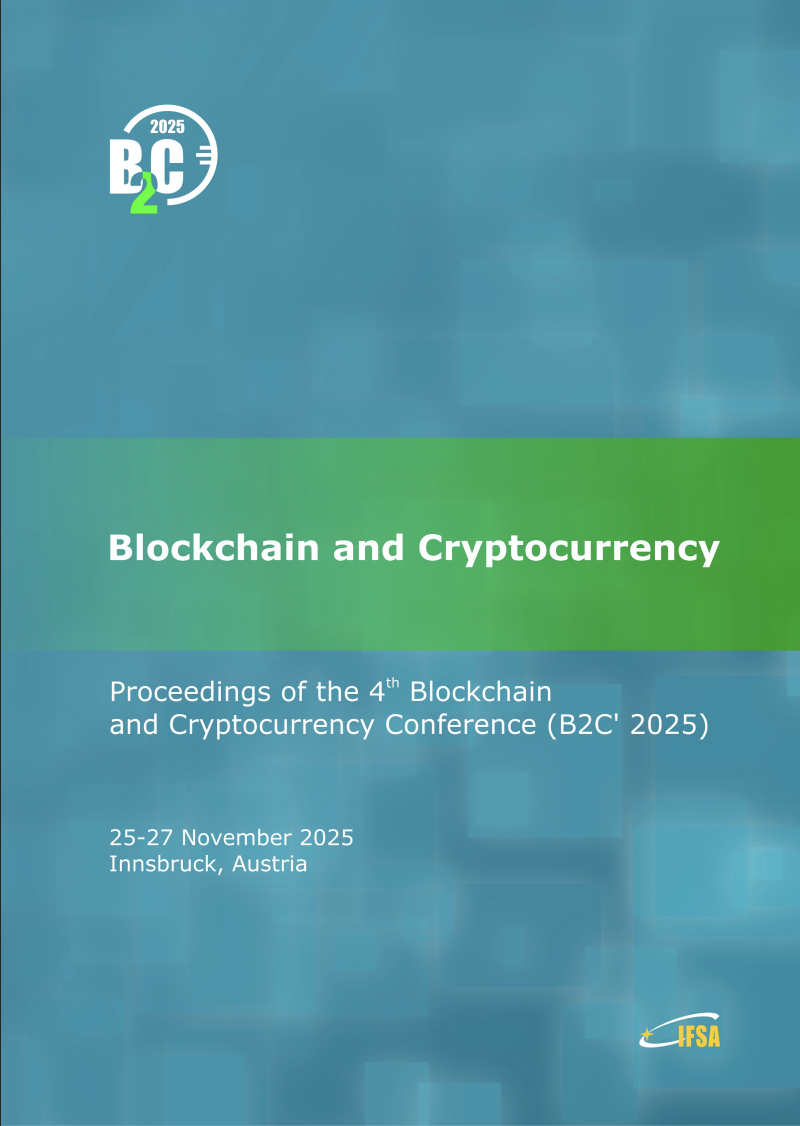
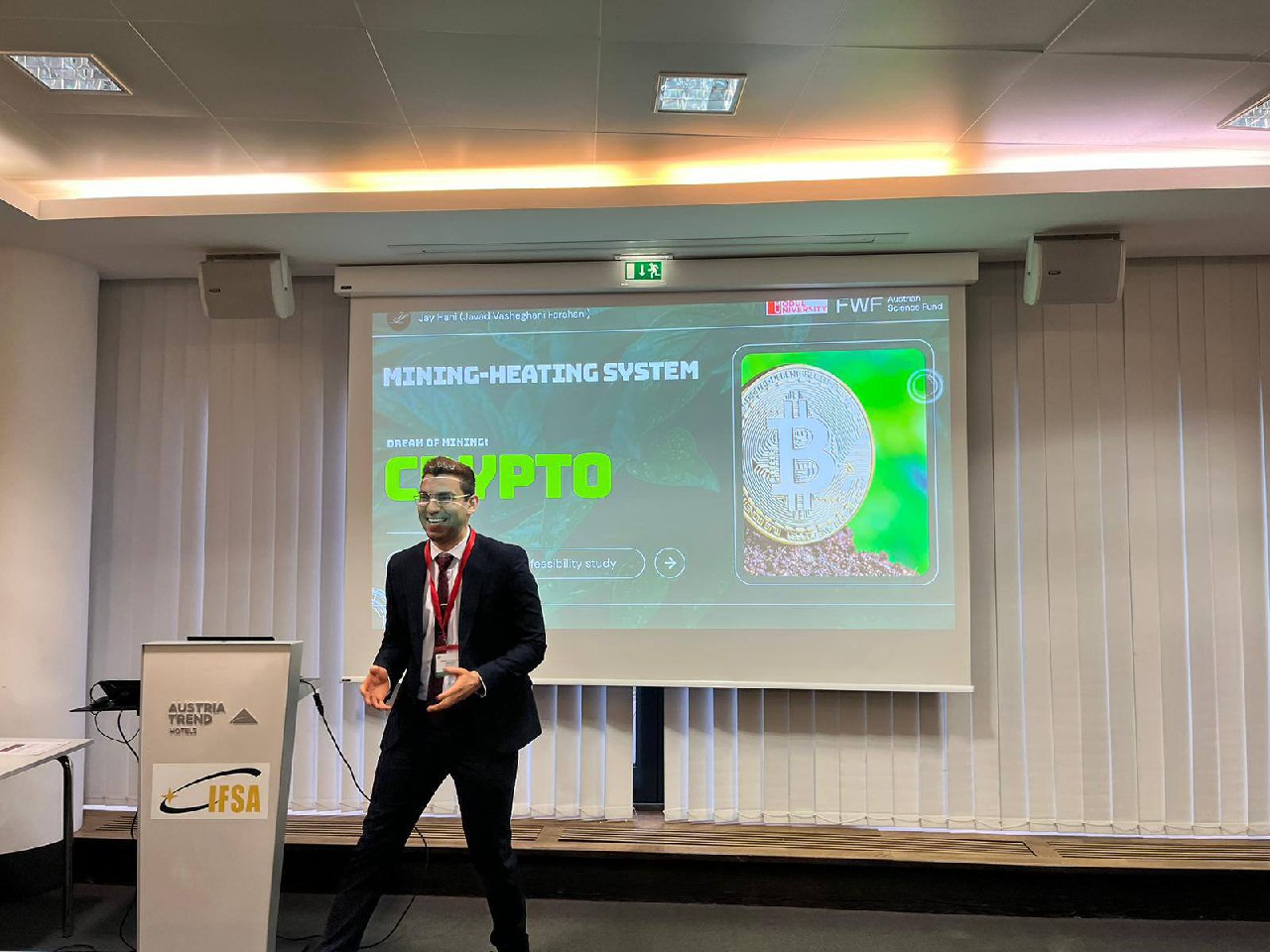
The first version of this work was presented at the 4th Blockchain and Cryptocurrency Conference (B2C’ 2025), held in Innsbruck, Austria, from 25 to 27 November 2025. In the conference proceedings, the paper appeared under the title “Feasibility and performance of blockchain dual-purpose mining–heating systems.” The B2C’ 2025 proceedings were published by IFSA Publishing and list the conference volume Blockchain and Cryptocurrency with ISBN 978-84-09-78844-6.
At that stage, the project was centered on the development of the initial simulation framework. The goal was to explore whether blockchain mining-heating systems could be modeled as dual-purpose infrastructures capable of combining cryptographic computation with space heating. Presenting the early version at the conference was an important step, not only for sharing the idea, but also for receiving feedback that helped sharpen the direction of the research.
From early simulation to a more rigorous research design
After the conference, I continued developing the project with a more rigorous methodological approach. This next stage involved improving the simulation itself and broadening the analysis beyond technical feasibility alone.
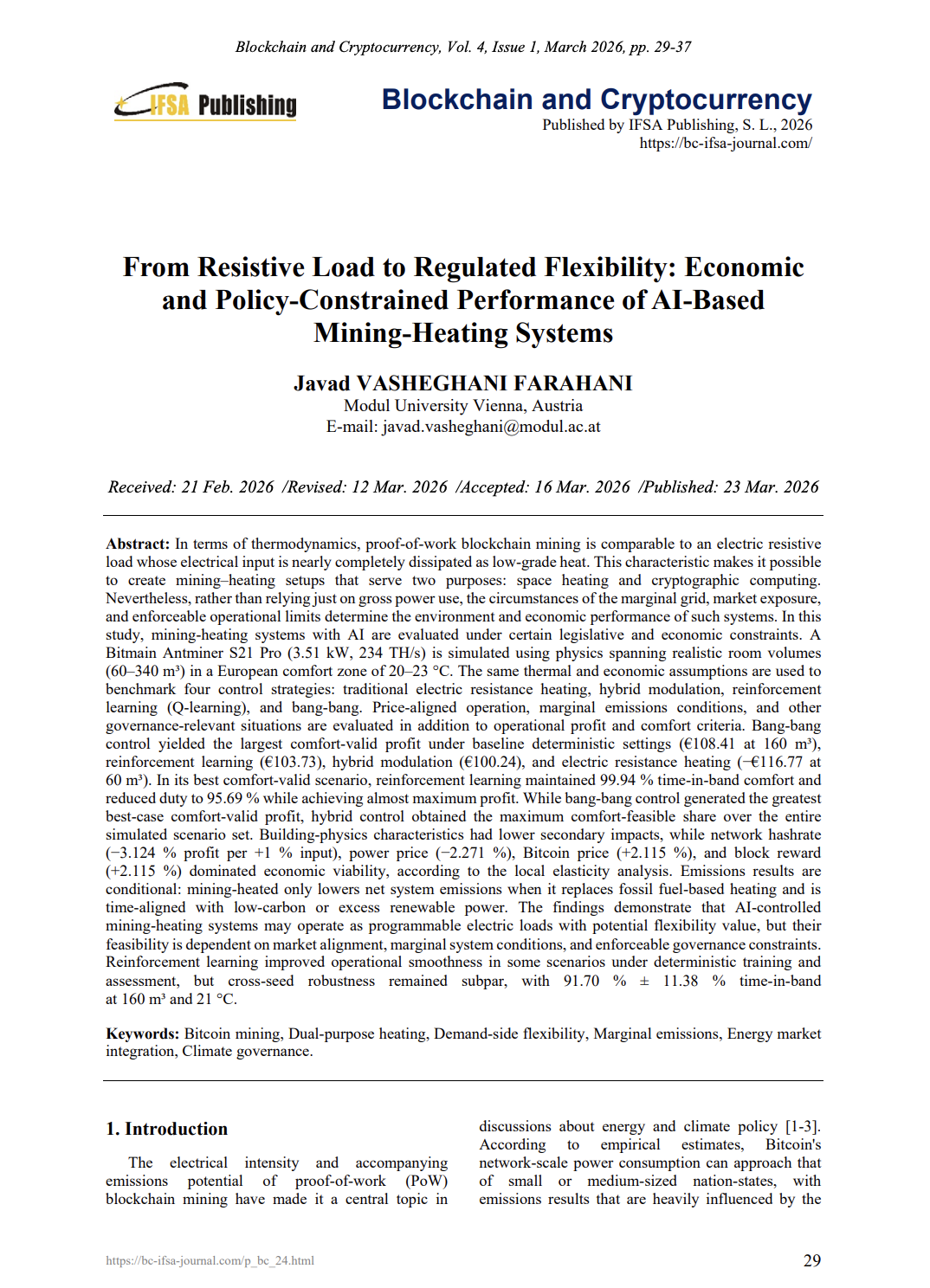
The result was a later open-access journal article titled “From Resistive Load to Regulated Flexibility: Economic and Policy-Constrained Performance of AI-Based Mining-Heating Systems,” published in Blockchain and Cryptocurrency, Vol. 4, Issue 1, March 2026, pp. 29–37. The article was received on 21 February 2026, revised on 12 March 2026, accepted on 16 March 2026, and published on 23 March 2026.
This later version moved the work forward in several important ways. According to the abstract, the article simulated a Bitmain Antminer S21 Pro (3.51 kW, 234 TH/s) across realistic room volumes of 60–340 m³ within a European comfort zone of 20–23 °C. It also benchmarked four control strategies: traditional electric resistance heating, hybrid modulation, reinforcement learning (Q-learning), and bang-bang control.
Expanding the project: technical, economic, and policy dimensions
What changed most significantly in the journal article was the scope of the analysis. The project was no longer framed only as a technical simulation. It became a more complete study of how mining-heating systems perform under economic constraints, market exposure, and enforceable policy conditions.
The journal abstract makes this shift clear. It argues that the environmental and economic performance of mining-heating systems depends not only on gross electricity use, but also on the marginal grid context, market alignment, and operational limits imposed by governance and regulation.
This made it possible to approach the subject in a more rigorous and realistic way. Rather than asking only whether such a system can function, the later paper asks under what conditions it becomes economically viable, environmentally defensible, and politically relevant.
What the later paper showed
The published article found that bang-bang control achieved the highest comfort-valid profit under baseline deterministic settings at €108.41 for a 160 m³ room, while reinforcement learning reached €103.73, hybrid modulation €100.24, and traditional electric resistance heating produced −€116.77 at 60 m³. In one of its strongest comfort-valid scenarios, reinforcement learning maintained 99.94% time-in-band comfort while reducing duty to 95.69% and achieving near-maximum profit.
At the same time, the article emphasized that emissions outcomes are conditional. According to the abstract, mining-heated systems only reduce net system emissions when they replace fossil fuel-based heating and operate in alignment with low-carbon or excess renewable power. The paper concludes that AI-controlled mining-heating systems may have value as programmable electric loads, but their feasibility depends on market conditions, marginal system dynamics, and enforceable governance constraints.
Why this research path mattered
For me, this project reflects an important research process: starting with a promising idea, testing it through an initial simulation, presenting it in a conference setting to receive feedback, and then developing it into a more rigorous open-access publication with stronger analytical depth.
That progression also mirrors a broader principle in my work. Emerging technology research is often most useful when it moves step by step: from concept, to model, to critique, to refinement, and finally to a more mature contribution that addresses not only technical performance but also institutional, economic, and policy implications.
You can view the open-access journal article here:
You can view the conference proceedings information here:
B2C’ 2025 Conference Proceedings.