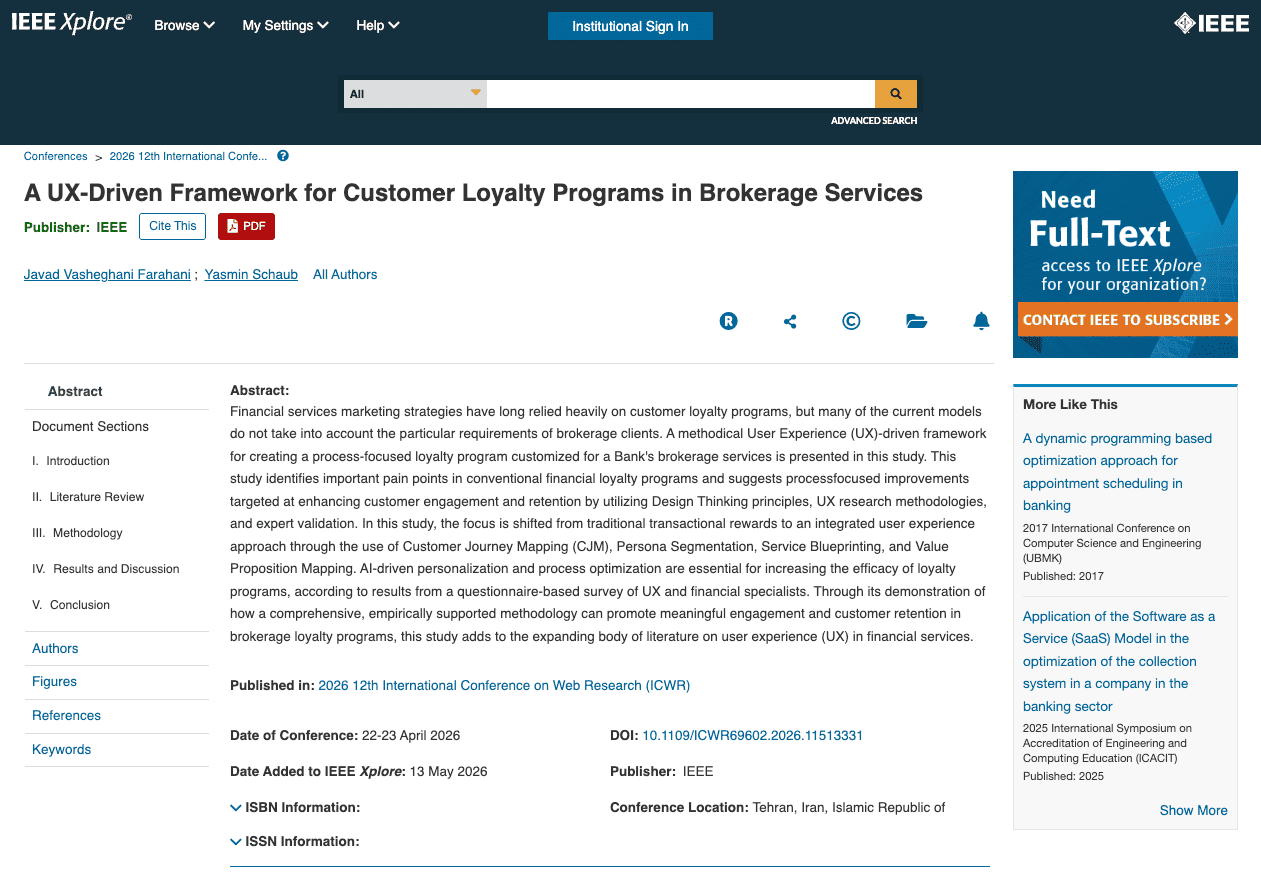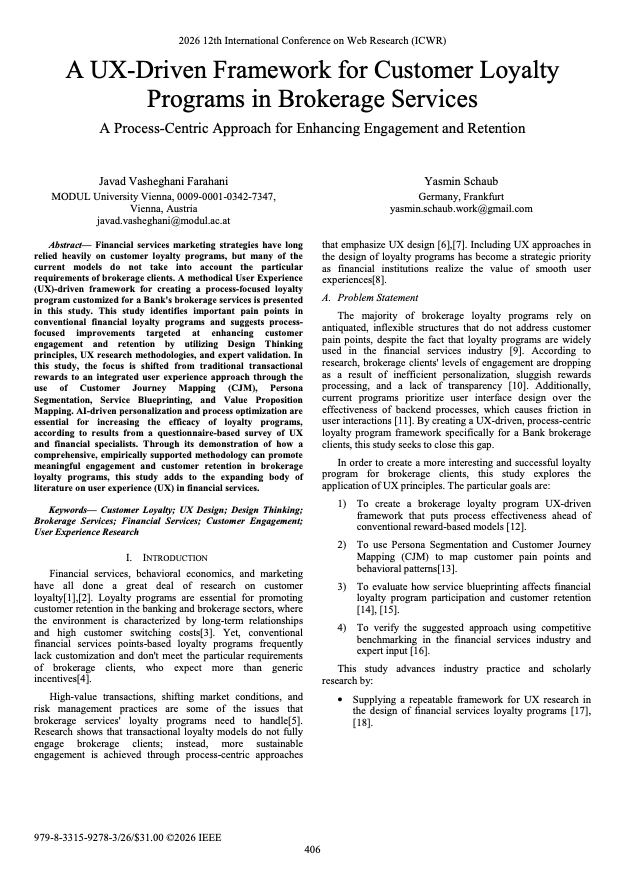
I am pleased to share that my paper, “A UX-Driven Framework for Customer Loyalty Programs in Brokerage Services: A Process-Centric Approach for Enhancing Engagement and Retention,” co-authored with Yasmin Schaub, was published in the 2026 12th International Conference on Web Research (ICWR) by IEEE.
This research connects several areas that are central to my academic and professional work: product management, UX research, design thinking, financial services innovation, customer engagement, service design, and process optimization.
The paper began not only as an academic idea, but as a real product and design management experience. During my time as a Technical Product Manager, our team worked on a brokerage-related project for a well-known banking client. The project required many meetings with managers and stakeholders, careful business requirement analysis, and close collaboration with customers to understand their expectations, frustrations, and motivations.
What made the project especially valuable was that it was not limited to designing screens or improving an interface. It required understanding the full customer experience: how brokerage clients discover a loyalty program, how they evaluate its benefits, how they interact with it, where they lose trust, and which processes create friction. This practical experience later became the foundation for a structured academic study.
From Product Management Practice to Academic Research
In the early stages of the project, the main goal was to understand how a loyalty program could create real value for brokerage customers. Brokerage services are very different from ordinary retail or entertainment loyalty programs. Customers are usually dealing with financial decisions, risk, market uncertainty, and long-term investment goals. Therefore, a generic points-based loyalty model is often not enough.
As a product team, we worked through the problem from both business and user perspectives. We prepared business requirements, analyzed stakeholder expectations, and translated strategic goals into design and product requirements. At the same time, we stayed close to customers through interviews, research activities, and design thinking workshops.
Yasmin Schaub, who was the product designer in my team, contributed to the design side of the project. Later, I decided to transform this practical work into an academic paper by extending the analysis, gathering additional input from designers and experts, and positioning the project within the broader literature on UX-driven financial service design.
Why Brokerage Loyalty Programs Need a UX-Driven Approach
Many loyalty programs in financial services still rely on traditional reward systems. These programs often focus on points, discounts, or generic benefits. However, brokerage customers usually expect more than simple rewards. They need transparency, trust, guidance, personalization, and a smooth experience across digital and service touchpoints.
In our study, we argued that loyalty programs in brokerage services should move from a purely transactional model toward a process-centric UX model. This means that the program should not only reward customers after transactions, but also improve the overall experience around onboarding, engagement, education, support, reward tracking, and long-term retention.
The paper identifies several common pain points in brokerage loyalty programs, including unclear point accumulation rules, slow reward processing, limited personalization, lack of transparency, and weak alignment between customer needs and program benefits.
Methodology: Design Thinking, UX Research, and Service Design
The research applies a structured UX and design management methodology. The framework includes:
Business Model Canvas to align the loyalty program with the bank’s strategic goals and value creation logic.
Customer Journey Mapping to identify customer pain points across awareness, consideration, signup, engagement, retention, and support.
Persona Segmentation to classify different brokerage customer groups based on their behaviors, expectations, experience levels, and engagement patterns.
Value Proposition Mapping to connect customer pains and gains with loyalty program benefits.
Service Blueprinting to analyze both visible customer interactions and invisible backstage processes, including account verification, point tracking, reward fulfillment, customer support, compliance, and IT infrastructure.
Expert validation and competitive benchmarking to compare the proposed framework with financial loyalty practices and collect feedback from UX, design, product, academic, and financial service professionals.
This combination allowed the study to go beyond surface-level UI design and examine how loyalty programs can be improved through end-to-end product and service design.
Key Findings
The study found that brokerage loyalty programs can become more effective when they prioritize personalization, transparency, and process efficiency.
Customer Journey Mapping was especially useful for identifying friction points in the customer experience. Persona Segmentation helped clarify that brokerage clients are not a single homogeneous group. Beginners, early-stage traders, experienced investors, high-value clients, and low-engagement users all require different forms of support and motivation.
The research also highlights the importance of service blueprinting. In financial services, many user frustrations are not caused by visual interface problems alone. They are often caused by backend delays, unclear rules, weak automation, fragmented communication, or poor integration between customer-facing and internal processes.
Expert feedback supported the idea that process optimization can have a stronger impact than UI improvements alone. In other words, a visually attractive interface is not enough if the underlying service process remains slow, confusing, or impersonal.
Product Management and Design Management Contribution
From a product management perspective, this research shows how customer loyalty programs can be designed as strategic digital products rather than isolated marketing tools.
A strong brokerage loyalty program should connect business objectives with customer value. It should support retention, improve engagement, increase trust, and strengthen the relationship between the financial institution and its clients.
From a design management perspective, the paper demonstrates how structured design methods can help organizations make better product decisions. Design Thinking, Customer Journey Mapping, Persona Segmentation, Value Proposition Mapping, and Service Blueprinting are not only creative tools; they are decision-making tools that help teams reduce uncertainty, align stakeholders, and build more user-centered financial services.
This is also connected to my broader research interest in how design, technology, and strategy can work together. In another research direction on my website, I have also explored how design principles shape user trust, accessibility, and transparency in digital environments, especially in Web3 and emerging technology contexts.
Practical Implications for Banks and Brokerage Platforms
The findings suggest that banks and brokerage platforms should rethink loyalty programs as integrated customer experience systems. Instead of focusing only on rewards, they should consider:
- clearer onboarding and communication,
- real-time reward tracking,
- personalized benefits based on trading behavior,
- educational content for different investor segments,
- simplified redemption processes,
- AI-driven recommendations,
- transparent rules and benefit structures,
- and stronger integration between front-end experience and back-end operations.
For financial institutions, this approach can improve customer engagement and support long-term retention. For product managers and UX teams, the framework provides a repeatable process for designing loyalty programs that are more aligned with real customer behavior.
Publication Details
Paper title: A UX-Driven Framework for Customer Loyalty Programs in Brokerage Services: A Process-Centric Approach for Enhancing Engagement and Retention
Authors: Javad Vasheghani Farahani and Yasmin Schaub
Conference: 2026 12th International Conference on Web Research (ICWR)
Publisher: IEEE
Pages: 406–413
DOI: 10.1109/ICWR69602.2026.11513331
Cite this publication
Farahani, J. V., & Schaub, Y. (2026). A UX-driven framework for customer loyalty programs in brokerage services: A process-centric approach for enhancing engagement and retention. In 2026 12th International Conference on Web Research (ICWR) (pp. 406–413). IEEE. https://doi.org/10.1109/ICWR69602.2026.11513331