When Energy Data Becomes Institutional Reality: Introducing the Automated Constitution Model
I am pleased to share our new open-access article:
“When Energy Data Becomes Institutional Reality: Blockchain-Secured Digital Twins, Certification, and Accountability in Sustainable Urban Infrastructure”
co-authored with Tan Gürpinar and published in Sustainability.
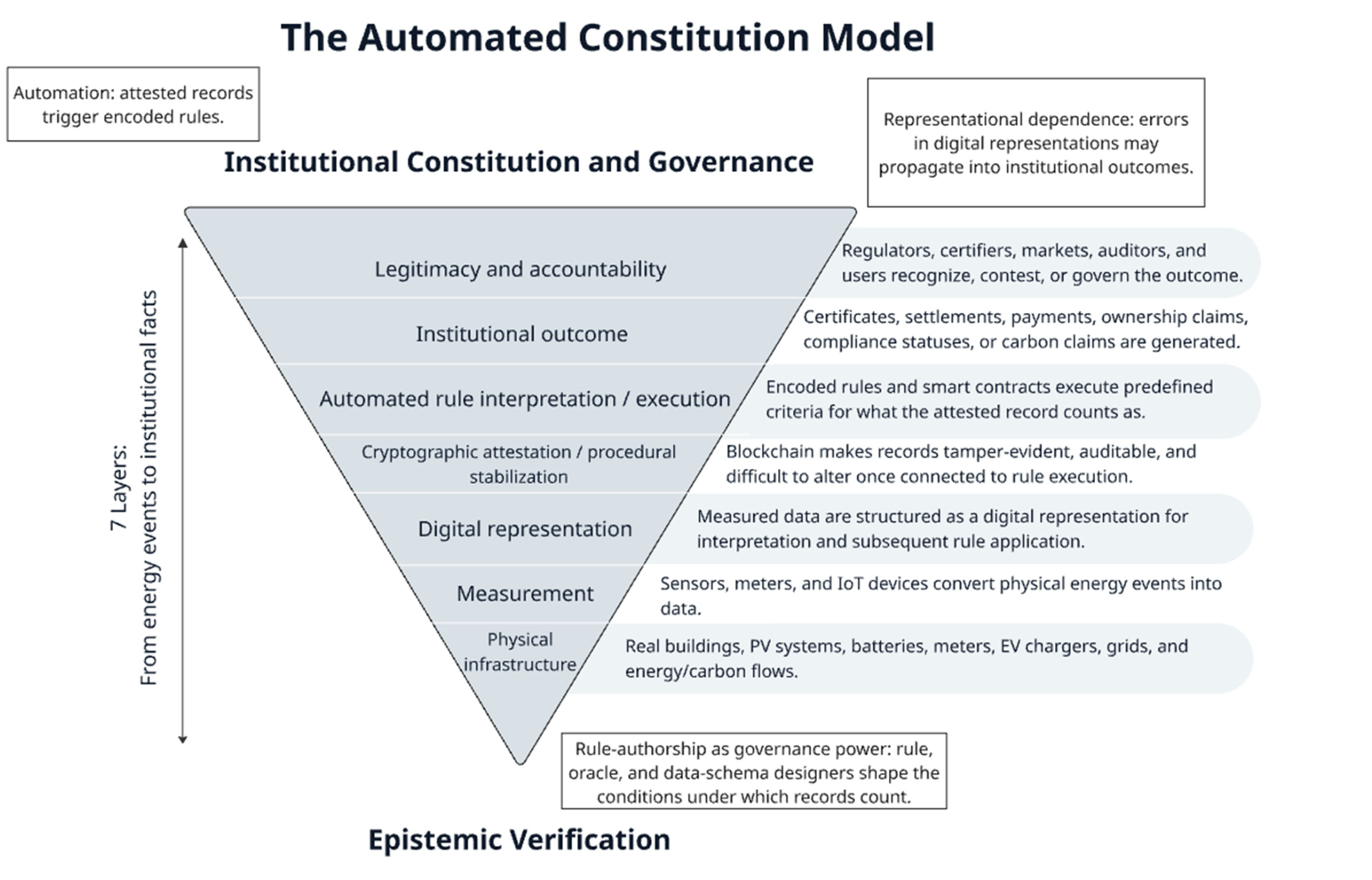
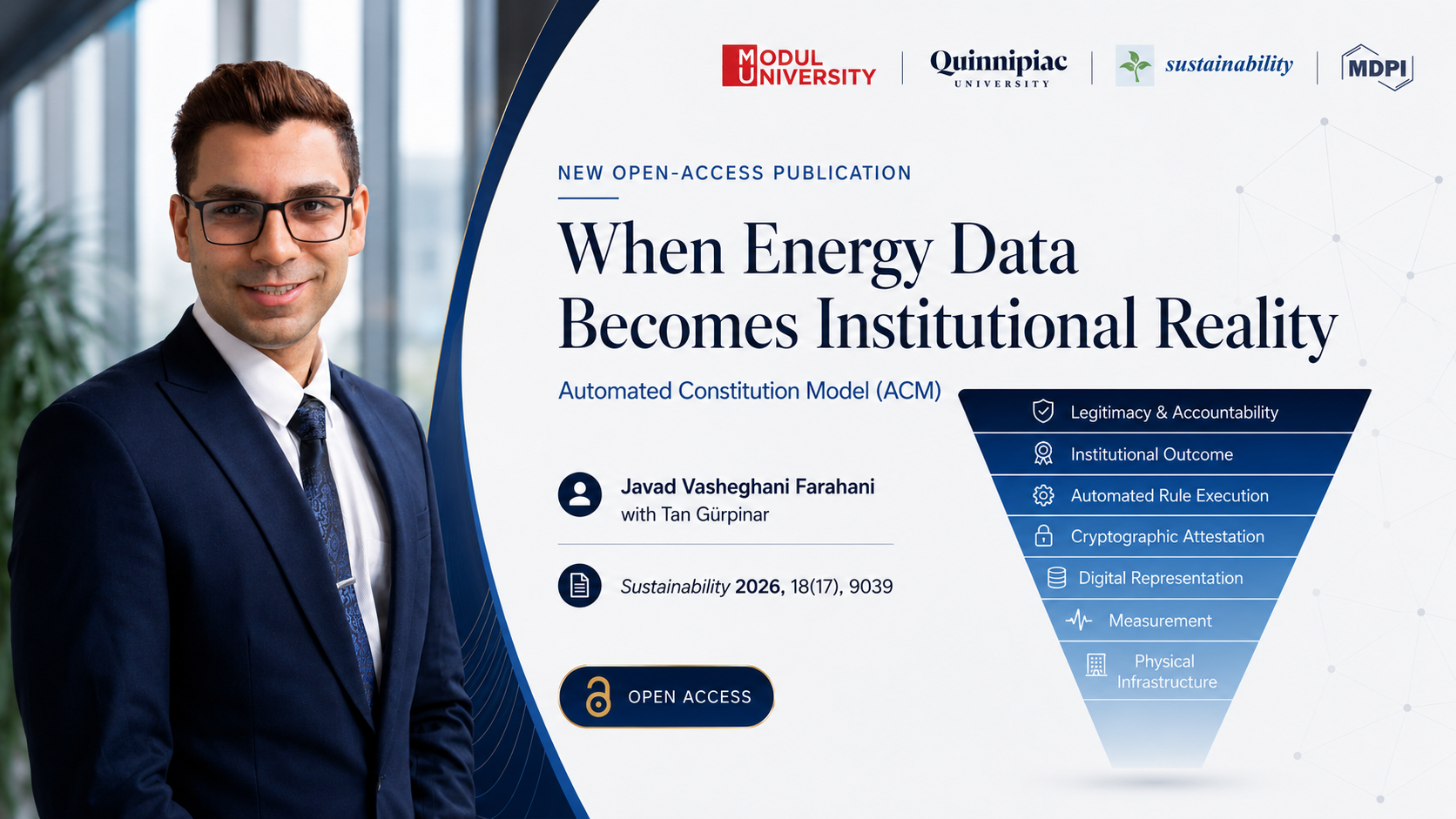
The paper introduces the Automated Constitution Model (ACM), a seven-layer framework designed to explain how digitally represented and cryptographically verified energy events can move beyond data verification and contribute to institutionally recognized outcomes.
Citation:
Vasheghani Farahani, J., & Gürpinar, T. (2026). When Energy Data Becomes Institutional Reality: Blockchain-Secured Digital Twins, Certification, and Accountability in Sustainable Urban Infrastructure. Sustainability, 18(17), 9039.
https://doi.org/10.3390/su18179039
From Data Verification to Institutional Reality
Digital twins are commonly understood as systems that represent physical assets, processes, and events in digital form.
When blockchain is added, these representations can also become more tamper-evident, traceable, auditable, and verifiable.
However, verification alone does not explain what happens when these records begin to determine outcomes such as:
- renewable-energy certificates,
- compliance statuses,
- settlement claims,
- payment rights,
- ownership records, or
- carbon-related claims.
This distinction became the central question of our study:
When does verified digital information stop merely representing a physical event and begin contributing to an institutional fact?
The Automated Constitution Model was developed to provide a structured answer.
The Automated Constitution Model
The ACM distinguishes seven interconnected layers:
- Physical infrastructure
- Measurement
- Digital representation
- Cryptographic attestation and procedural stabilization
- Automated rule interpretation and execution
- Institutional outcome
- Legitimacy and accountability
The lower layers primarily concern epistemic verification: establishing what happened, representing it digitally, and providing evidence that the record has not been improperly altered.
The transition occurs when verified records are interpreted through encoded rules, smart contracts, certification procedures, compliance frameworks, or other governance mechanisms.
At this point, the system can begin producing outcomes that organizations, regulators, markets, and other institutional actors recognize and act upon.
The digital twin therefore becomes more than an information system. Under specific technical and institutional conditions, it can participate in the constitution of institutional reality.
How the Idea Developed
The conceptual direction of this research developed gradually.
In March 2026, I presented “From Epistemology to Ontology: Blockchain Digital Twins and the Institutional Authority of Energy Data” at the workshop Tokenization and Digital Twins: Negotiating Reality and Fiction, organized by the Zug Institute for Blockchain Research at the University of Lucerne in Switzerland.
Read about the presentation in Switzerland →
That presentation examined an emerging question concerning the institutional authority of digitally verified energy records.
The presentation, subsequent discussions, and further conceptual development helped refine the distinction between two fundamentally different functions of blockchain-secured digital twins:
verifying information about reality and participating in the institutional constitution of outcomes based on that information.
The Automated Constitution Model emerged from the gradual development of this distinction.
Why Accountability Matters
The transition from verification to institutional action also changes the accountability structure of digital infrastructure.
Consider a renewable-energy certificate that is generated automatically.
The final institutional outcome may depend on several interconnected components:
physical event → sensor → data representation → blockchain attestation → encoded rule → certificate → institutional recognition
An error at any earlier stage may propagate through the system and affect the final outcome.
Accountability therefore cannot necessarily be attributed to a single actor.
Depending on the system, responsibility may be distributed across:
- infrastructure operators,
- sensor and IoT operators,
- data-model designers,
- oracle providers,
- software developers,
- smart-contract authors,
- certifiers,
- platform operators,
- auditors, and
- regulators.
This is why the seventh layer of the ACM focuses explicitly on legitimacy and accountability.
The important question is not only whether an automated outcome was technically generated correctly, but also:
Who has the authority to recognize it, contest it, reverse it, or accept responsibility when it is wrong?
Connecting My Earlier Research
This study also represents a progression in my research on blockchain, energy systems, and digital infrastructure.
My earlier work examined how blockchain can support verifiable and tamper-evident energy records, including the development and empirical assessment of a blockchain-secured solar-energy logger for edge-IoT environments.
Read the blockchain-secured solar-energy logger study →
The new paper moves one level beyond verification.
Instead of asking only:
Can we trust the energy record?
it asks:
What happens when institutions begin using that trusted record to generate consequential outcomes?
This shift—from information integrity to institutional constitution—is the central contribution of the Automated Constitution Model.
Research Implications
The framework has potential applications wherever verified digital records interact with automated institutional rules, including:
- renewable-energy certification,
- electricity-market settlement,
- automated regulatory compliance,
- carbon accounting,
- blockchain-based energy markets,
- smart buildings,
- distributed energy systems,
- digital product and asset records, and
- other forms of digitally governed infrastructure.
The framework also creates several opportunities for empirical research.
A particularly important next step is to examine where the seven-layer process fails, whether failures propagate across layers, and how institutional actors assign responsibility when automated outcomes are based on incorrect, incomplete, or contested digital representations.
Acknowledgment
I would like to express my sincere appreciation to Prof. Dr. Horst Treiblmaier, Full Professor and Head of the School of International Management at Modul University Vienna, for his valuable input and supervision during the development of this research.
His feedback and discussions contributed to refining the conceptual direction of the work and to strengthening my understanding of the relationship between blockchain, governance, institutions, and automated decision systems.
Open-Access Publication
The article is published open access in Sustainability:
Vasheghani Farahani, J., & Gürpinar, T. (2026).
When Energy Data Becomes Institutional Reality: Blockchain-Secured Digital Twins, Certification, and Accountability in Sustainable Urban Infrastructure.
Sustainability, 18(17), 9039.
DOI: https://doi.org/10.3390/su18179039
Closing Thought
The fundamental question behind this research is relatively simple:
Once a digital record can be trusted, what gives that record the authority to change institutional reality?
The Automated Constitution Model provides a framework for examining that transition—from physical events, through digital verification and automated rules, to institutional outcomes, legitimacy, and accountability.